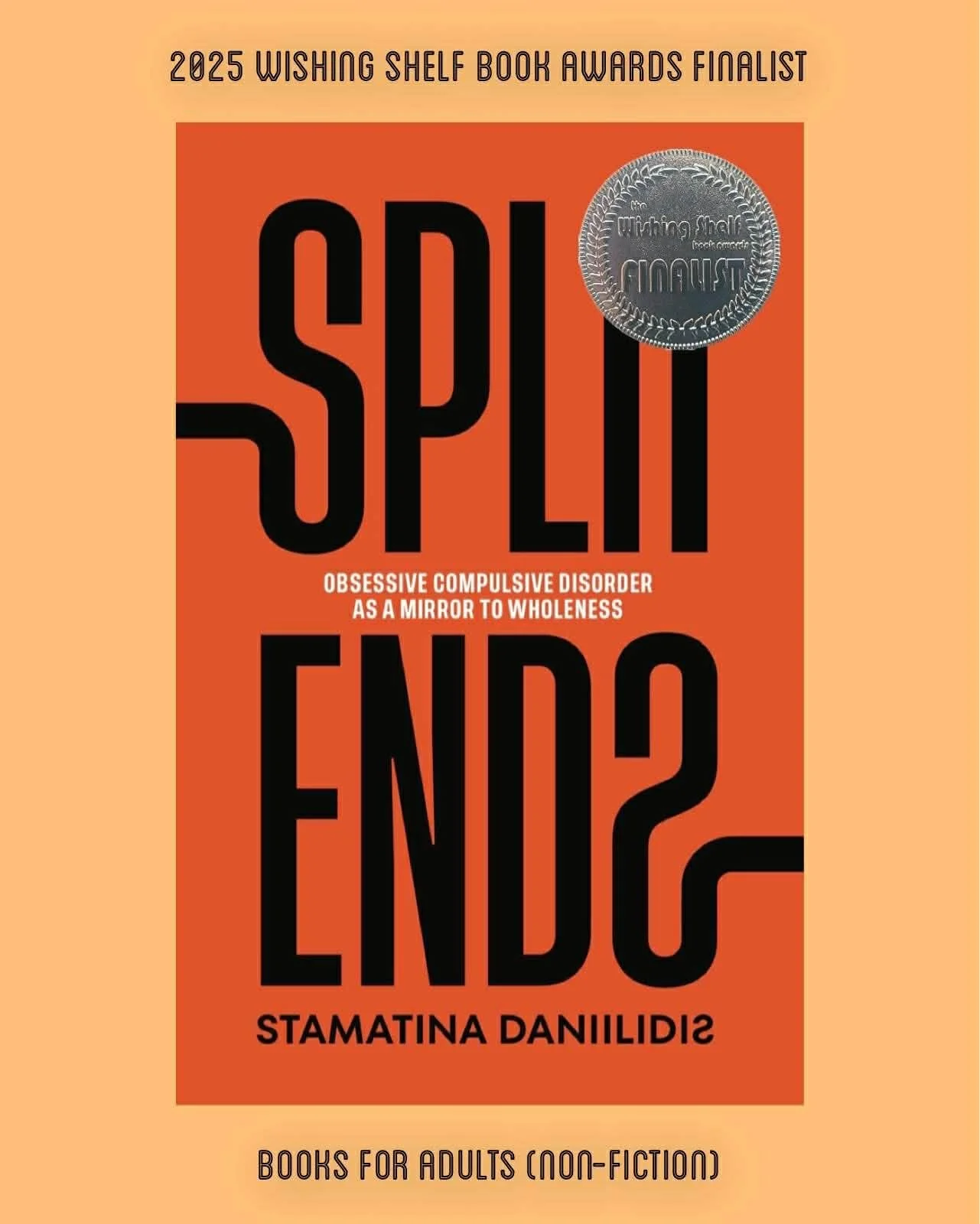
C.G. Jung Society of Montreal: SPLIT ENDS: Obsessive Compulsive Disorder as a Mirror to Wholeness Book Review
BY SUSAN MEINDL, MA — JANUARY 2026 NEWSLETTER
“This book is a short and helpful personal reflection on the author’s experience with Obsessive Compulsive Disorder (OCD). In it, Daniilidis guides us towards an understanding of the Jungian concept of “wholeness versus perfection,” a concept which CBT therapy, with its focus on concrete solutions, correcting erroneous thinking, extinguishing compulsive behaviors and calming anxious bodily responses, is not typically tuned to consider.
One of the central premises that Daniilidis explores is that OCD is fundamentally rooted in theinability to accept the band-width of the whole self. This inability arises from the sense, often learned as a child, that “the world” and those close to us, would prefer us not to be harmful, controversial, or messy. For the sensitive spirit, particularly one who has been punished for exhibiting such failings, the injunction to be perfect evolves from a mere aspiration into an absolute directive.
Detailing her history, the author describes how her OCD stemmed from an excessive and dangerous “hyper-analysis” of her natural feelings. As she strove to “minimize her moral footprint” (Responsibility OCD), she suffered the dangers and limits of a conditional existence, not recognizing that “the sliver of personality she had to inhabit to stay on the tightrope of perfection” was simply too small a part of herself to sustain the effort. Among all her conscious fears there was also the less conscious fear of “losing herself,” or her identity, to this self-imposed limitation.
To shove aside the shadow and strive to stay always in the light leads, of necessity, to one-sidedness and alienation from the totality of the human self. This concern with losing self was symbolically expressed by her childhood fear that losing something which belonged to her, even a sheet of looseleaf which she had handed to a classmate, could become a threat to a shaky identity.
Daniilidis reflects on how the pursuit of perfection creates an oppressive internal environment forcing the exile of necessary, if uncomfortable, aspects of the self— the contradictions that constitute human complexity. She illustrates this dynamic through the universal themes of OCD, which reflect the ways in which humanity denies and exiles its potential for darkness and harm. Examples include “Harm OCD,” the fear that an intrusive thought would make someone else ill; “Responsibility OCD,” the requirement to be perfect and minimize her moral footprint; “Sexual OCD,” the elimination of sexually intrusive thoughts; “Checking OCD,” having to check appliances and locks; and “Religious Scrupulosity,” only later realizing her “fear of God” was correlated to her relationship to her demanding mother. In her own life, Daniilidis reveals that she had always repressed her anger while allowing others to express theirs, often at her expense.
She came to recognize that her intrusive thoughts about anger towards others were signals coming from a deep place inside her, leading to the realization that grief and anger could and did coexist and were not necessarily opposites. Her desire to protect others from her shadow aspects—her sexuality, disagreeableness, and controversiality—had led her to keep everything inside to avoid “casting a shadow” onto others. However, as Jung suggests, “I must cast a shadow if I am to be whole.”
The book makes the argument that obsessive and intrusive thoughts are not merely the product of faulty brain circuitry, but rather the product of repressed contents which are parts of the personality exiled from the Self that can also be understood as attempts to confront original pain or integrate fallibility. The author notes that the self-cautionary thought “I could never,” is particularly dangerous because the shadowy selves will find a way to come through the back door if one consistently tries to be “god-like” and superhuman.
Daniilidis describes punishing herself throughout her life for having intrusive thoughts and “treating herself like a criminal.” She eventually came to understand that this cruelty stemmed from the savage, cruel, sadistic, and unrelenting inner judge, whose appetite for suffering was insatiable—“No amount of suffering will suffice.” Her path to integrating human contradictions required a radical confrontation with the internal mechanisms of self-rejection.
Daniilidis then describes how she was intuitively drawn to Jungian ideas, particularly the ideas around “wholeness” versus perfection, because accepting a relationship to Shadow and meeting the challenge of “holding the tension of the opposites” were necessary to her healing from her, at times, life-threatening OCD.
The book underscores that being lovingly witnessed, for example in therapy, helps dissolve shame and teaches that the greatest healing lies in “the art of being a friend to oneself.” She argues that the ultimate shift occurs when an individual understands his/her multi-dimensionality and their focus moves from compensating for imperfections to simply gaining more inner freedom and choice.
In the end, Daniilidis became convinced that obsessions are seldom, if ever, meaningless, understanding that the exaggerated concerns that the OCD sufferer experiences exist in relation to deeply held human values—to be acceptable, to be loveable, and to not bring harm to those we love. These values are best supported by trusting in an authentic expression of a self which is “whole” because it includes and tolerates its own failings while also expressing love, tolerance and good will towards others.”
Stamatina x Your Dose. podcast
Split Ends & Self-Discovery: OCD, Shadow Work, and Unconditional Acceptance
“In this powerful and poetic episode, Emily sits down with Stamatina Daniilidis – community worker, author of Split Ends: Obsessive Compulsive Disorder as a Mirror to Wholeness, and passionate mental health advocate.
Stamatina shares her story of living with OCD since childhood, the intense isolation of contamination OCD during the pandemic, and the pivotal moments that led to healing.
She discusses the limitations of traditional therapy, her experience with Jungian analysis, and how exploring the unconscious mind helped uncover the roots of her compulsions – from grief and anger to responsibility and shame.”
(via Your Dose.)